
IMO Meaning in Text | What Does IMO Mean?
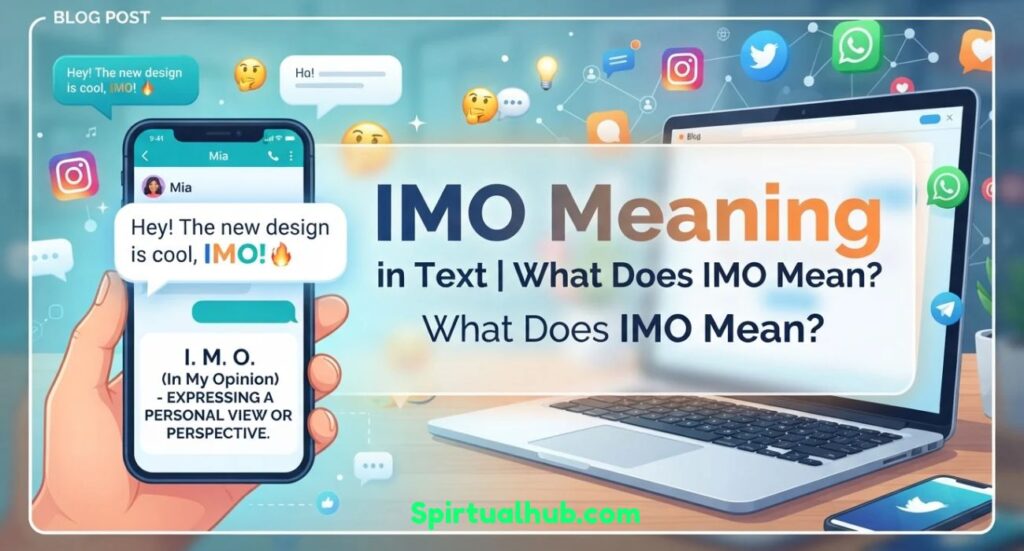
IMO means “in my opinion” in text messages, online chats, and social media posts. People use this abbreviation to share a personal opinion, express a preference, or give advice without writing the full phrase.
For example, someone might text, “IMO, this movie is better than the first one.” This means the person believes the movie is better, but they are sharing a personal viewpoint rather than an objective fact.
You may see IMO in text messages, TikTok comments, Instagram captions, Snapchat messages, WhatsApp chats, and gaming conversations. Understanding its meaning makes online conversations easier to follow.
What Does IMO Mean in Text?
IMO stands for “in my opinion.” It is a common internet abbreviation that people use when sharing their thoughts or personal judgments.
Instead of typing “in my opinion,” someone can simply write IMO. It saves time and keeps the message short.
For example:
- “IMO, pizza tastes better than burgers.”
- “IMO, you should talk to your teacher.”
- “That was the best episode, IMO.”
- “IMO, we should leave early.”
In each example, the speaker expresses a personal belief or preference. Other people may agree or disagree, and that is perfectly normal.
IMO does not mean that something is automatically true. It simply tells the reader that the statement reflects the sender’s viewpoint.
Read Also: Elegy Meaning | Definition, Examples, Types & Uses
What Is the IMO Slang Meaning?
The IMO slang meaning is “in my opinion.” People use it in casual conversations to share thoughts, recommendations, judgments, or personal preferences.
For example, a friend might say, “IMO, you look better in the blue shirt.” The friend is expressing a personal preference rather than stating a fact that everyone must accept.
IMO is informal, so it works well in text messages, online discussions, and social media comments. It can also make a strong statement sound more like a personal viewpoint.
However, IMO does not automatically make a message polite. The words that follow it still matter. Saying “IMO, that idea needs work” sounds different from saying “IMO, you’re completely clueless.”
The abbreviation itself is generally neutral. Its tone depends on the message, the relationship between the people, and the situation.
How Context Changes the Meaning of IMO
Although IMO usually means “in my opinion” in casual online conversations, context helps you understand how someone intends to use it.
Here are three common situations:
- Sharing a preference: “IMO, summer is the best season.” The person is expressing a personal choice.
- Giving advice: “IMO, you should wait before making a decision.” The sender is offering a recommendation.
- Disagreeing with someone: “IMO, that explanation doesn’t make sense.” The sender is expressing a different viewpoint.
IMO can also have a different meaning in professional or technical contexts. For example, the International Maritime Organization, a United Nations specialized agency concerned with international shipping, uses the same initials.
The surrounding words usually make the intended meaning clear. If someone uses IMO in a conversation about movies, school, or everyday life, “in my opinion” is generally the most likely interpretation.
How to use IMO or IMHO
IMO and IMHO are similar internet abbreviations, but they have slightly different meanings.
- IMO: In my opinion.
- IMHO: In my humble opinion.
People use both expressions to introduce a personal viewpoint. IMO is more direct, while IMHO can suggest modesty or soften a statement. However, IMHO does not always sound humble; the rest of the message determines the tone.
Examples:
- “IMO, this is the best restaurant in town.”
- “IMHO, we should try a different approach.”
- “IMO, the second game is more enjoyable.”
- “IMHO, your original idea was stronger.”
You can use either abbreviation in casual messages and online discussions. Choose IMO when you simply want to express your opinion. Choose IMHO when you want to use the traditional wording “in my humble opinion.”
Neither abbreviation guarantees that your message will sound polite. Clear wording and respect for other viewpoints matter more than the abbreviation itself.
IMO Meaning on Texts and Social Media
The meaning of IMO usually stays the same across messaging apps and social platforms. People use it to share personal views, recommend something, or explain why they prefer one option over another.
The main difference is how people use it in each setting.
Text Messages and Group Chats
In text messages and group chats, IMO helps people share opinions without typing a long introduction.
For example:
“IMO, we should meet at 5 instead of 6.”
The sender is suggesting a meeting time based on personal judgment. Other people can respond with their own preferences.
You might also see IMO in conversations about music, school activities, food, movies, or weekend plans. It is especially useful when several people are discussing different ideas.
TikTok and Instagram
On TikTok and Instagram, IMO often appears in comments, captions, and discussions about videos, trends, music, fashion, or entertainment.
For example:
“IMO, this is their best song so far.”
The commenter is sharing a personal opinion about the song. They are not claiming that everyone must agree.
You may also see IMO before a recommendation or criticism. The abbreviation can help readers recognize that the statement reflects one person’s viewpoint, although it does not remove the impact of harsh wording.
Snapchat and WhatsApp
On Snapchat and WhatsApp, IMO is a quick way to express an opinion during a private conversation.
For example:
“IMO, you should watch that series. I think you’ll enjoy it.”
A friend might also use it to discuss plans, compare products, or offer advice.
Because these conversations are often casual, people may write IMO in lowercase as “imo.” Both forms generally communicate the same meaning.
Online Forums and Gaming Chats
In online forums and gaming chats, IMO helps people share their views about strategies, characters, equipment, updates, and gameplay.
For example:
“IMO, the defensive strategy works better for this team.”
The player is offering a personal assessment rather than presenting a rule that applies to every situation.
In a forum discussion, someone might write, “IMO, the second explanation is more accurate.” This signals that the person is expressing a viewpoint, although the supporting evidence still matters when discussing factual claims.
IMO Examples in Real Conversations
The following examples show how people naturally use IMO in different situations. Each one includes enough context to make the meaning clear.
1: Friends
Example 1
Friend A: “Which movie should we watch tonight?”
Friend B: “IMO, the comedy looks more fun.”
Meaning: Friend B thinks the comedy is the better choice.
Example 2
Friend A: “Do you think I should buy these shoes?”
Friend B: “IMO, the black ones would match more of your clothes.”
Meaning: Friend B is offering a personal recommendation.
Example 3
Friend A: “That restaurant was amazing!”
Friend B: “IMO, their pasta was the best part.”
Meaning: Friend B is sharing a personal preference about the meal.
2: Classmates
Example 1
Student A: “Which topic should we choose for our presentation?”
Student B: “IMO, climate change would be interesting.”
Meaning: Student B is suggesting a topic based on personal judgment.
Example 2
Student A: “Was the science test difficult?”
Student B: “IMO, the last section was the hardest.”
Meaning: Student B is describing which section seemed most difficult to them.
Example 3
Student A: “Should we finish the slides today?”
Student B: “IMO, yes. Then we can practice tomorrow.”
Meaning: Student B believes completing the slides today is the better plan.
3: Social Media
Example 1
Commenter A: “Which album is your favorite?”
Commenter B: “IMO, the newest one is their best work.”
Meaning: Commenter B is expressing a personal opinion about the album.
Example 2
Commenter A: “Do you like this new trend?”
Commenter B: “IMO, the original version was more creative.”
Meaning: Commenter B prefers the original version.
Example 3
Commenter A: “Which game should I try first?”
Commenter B: “IMO, start with the second one. The story is easier to follow.”
Meaning: Commenter B is giving a recommendation based on personal preference.
What Tone Does IMO Have?
IMO usually has a casual, conversational, and neutral tone. It tells readers that the sender is expressing a personal opinion rather than necessarily stating an objective fact.
The abbreviation can also soften a statement by presenting it as one person’s viewpoint. For example, “IMO, we need a better plan” may sound less forceful than “We need a better plan.”
However, the tone depends on the words around it. A friendly suggestion can sound helpful, while an insulting comment can still sound rude even when it begins with IMO.
The relationship between the speakers also matters. Friends may use IMO freely, while a formal workplace message may benefit from writing “In my opinion” in full or explaining the reasoning behind the viewpoint.
Is IMO Rude?
No, IMO is not inherently rude. It is a neutral abbreviation that people commonly use to express their opinions.
Whether a message sounds rude depends on its wording and context.
Consider these examples:
- Polite: “IMO, we could improve this design by using simpler colors.”
- Direct: “IMO, this design doesn’t work very well.”
- Rude: “IMO, your idea is stupid.”
The first example offers constructive feedback. The second expresses criticism directly. The third uses insulting language.
IMO does not automatically make criticism polite or respectful. If you want to disagree without offending someone, explain your reasoning and avoid personal attacks.
Read Also: Zionist Meaning | What Does Zionist Mean?
How to Reply to IMO
Your response to IMO depends on what the other person says. You can agree, disagree politely, or ask them to explain their viewpoint.
You do not need to use another abbreviation in your reply. A simple, natural response is often the best choice.
Friendly Replies
If you agree with the person’s opinion, respond positively and keep the conversation going.
Examples:
- “I agree with you!”
- “Same here.”
- “That’s a good point.”
- “I was thinking the same thing.”
- “Yeah, I can see why you think that.”
Example:
Friend A: “IMO, this is the best song on the album.”
Friend B: “Same here! I’ve had it on repeat.”
This reply shows agreement and adds a little more information to the conversation.
When You Disagree
You can disagree with someone’s opinion without making the conversation uncomfortable. Acknowledge their viewpoint and explain your own.
Examples:
- “I see your point, but I prefer the first one.”
- “Fair enough. I think the other option works better.”
- “I get that, but I have a different opinion.”
- “That’s understandable. I just see it differently.”
Example:
Friend A: “IMO, the first movie was better.”
Friend B: “Fair enough, but I enjoyed the sequel more.”
Both people express their preferences without treating the disagreement as a personal conflict.
When You Want More Explanation
If you do not understand why someone holds a particular opinion, ask a simple follow-up question.
Examples:
- “What makes you think that?”
- “Why do you prefer that one?”
- “Can you explain your reasoning?”
- “What do you like most about it?”
Example:
Friend A: “IMO, this is the best phone to buy.”
Friend B: “Interesting. What features make it better?”
This response encourages a more detailed discussion instead of ending the conversation with a simple agreement or disagreement.
When to Use IMO
Use IMO when you want to express a personal viewpoint in a casual conversation. It works well when sharing preferences, offering suggestions, discussing entertainment, or responding to someone else’s ideas.
Common situations include:
- Sharing preferences: “IMO, chocolate ice cream tastes better.”
- Giving recommendations: “IMO, you should visit the museum first.”
- Discussing entertainment: “IMO, the book has a better ending.”
- Offering feedback: “IMO, the introduction needs a clearer explanation.”
- Joining online discussions: “IMO, the second option is more practical.”
- Talking in group chats: “IMO, Saturday works better for everyone.”
The abbreviation can be useful when people have different viewpoints because it makes the personal nature of a statement clear.
Still, use it naturally. You do not need to add IMO to every sentence that expresses a preference. In a relaxed conversation, your opinion may already be obvious from the wording.
When to Avoid IMO
Although IMO works well in casual communication, some situations call for more formal or precise language.
Consider avoiding the abbreviation in these situations:
- Formal emails: Write “In my opinion” or explain your recommendation clearly.
- Academic writing: Follow your instructor’s requirements and support arguments with evidence.
- Professional reports: Present the relevant facts and reasoning rather than relying on a casual abbreviation.
- Serious discussions: Use clear, thoughtful language when the topic requires sensitivity.
- Fact-based explanations: Do not use IMO to make an unsupported claim sound acceptable.
For example, writing “IMO, this medicine is safe” does not establish that the medicine is safe. Medical safety depends on reliable evidence and individual circumstances, not a personal opinion alone.
IMO is appropriate for expressing personal views, but it should not replace evidence when a discussion concerns facts, safety, or professional advice.
Examples of Using IMO Abbreviation
Here are additional examples of how IMO appears in everyday online communication.
| Situation | Example | Meaning |
| Food | “IMO, tacos are the best.” | The speaker prefers tacos. |
| Movies | “IMO, the ending was confusing.” | The speaker found the ending confusing. |
| Advice | “IMO, you should take a break.” | The sender recommends taking a break. |
| Shopping | “IMO, the cheaper option is better.” | The sender prefers the cheaper option. |
| School | “IMO, we should study together.” | The sender thinks studying together is a good idea. |
| Gaming | “IMO, this character is stronger.” | The player believes the character performs better. |
| Social media | “IMO, this trend has gone too far.” | The commenter expresses a personal judgment. |
| Group plans | “IMO, we should leave early.” | The sender prefers an earlier departure. |
IMO can appear at the beginning, middle, or end of a sentence.
For example:
- Beginning: “IMO, this is the best choice.”
- Middle: “This is, IMO, the best choice.”
- End: “This is the best choice, IMO.”
All three forms communicate a personal viewpoint. The beginning position is straightforward and easy to understand, especially for beginners.
Common Mistakes About IMO
People sometimes misunderstand IMO or use it in ways that make their messages less clear. Knowing these common mistakes can help you communicate more naturally.
1. Thinking IMO means a fact
IMO introduces a personal opinion. It does not prove that a statement is true.
2. Assuming IMO is always polite
The abbreviation can soften a message, but insulting or aggressive wording can still offend someone.
3. Confusing IMO with IMHO
IMO means “in my opinion,” while IMHO traditionally means “in my humble opinion.” Both introduce personal viewpoints, but IMHO includes the word “humble.”
4. Using IMO in every sentence
Repeating the abbreviation too often can make a message feel awkward. Use it when it helps clarify that you are sharing your own view.
5. Assuming capitalization changes the meaning
IMO and imo generally mean the same thing in texting. Capitalization is usually a matter of personal writing style.
6. Treating every disagreement as an argument
People can have different opinions without being unfriendly. IMO often helps introduce a viewpoint, but respectful wording is still important.
7. Confusing the texting meaning with other uses
In casual conversations, IMO usually means “in my opinion.” In discussions about international shipping, it may refer to the International Maritime Organization instead. Context helps distinguish the meanings.
IMO vs. Similar Slang Terms
IMO belongs to a larger group of internet abbreviations that people use to communicate quickly. Some express opinions, while others introduce honesty, agreement, or different kinds of responses.
The following comparisons explain the most relevant differences.
| Abbreviation | Full Form | Main Use |
| IMO | In my opinion | Shares a personal viewpoint |
| IMHO | In my humble opinion | Shares an opinion, traditionally with a modest tone |
| TBH | To be honest | Introduces an honest or candid statement |
| IIRC | If I remember correctly | Signals uncertainty about a memory |
| AFAIK | As far as I know | Expresses knowledge with a limitation |
| FYI | For your information | Shares information someone may find useful |
IMO vs. IMHO
IMO means “in my opinion,” while IMHO means “in my humble opinion.”
Both abbreviations introduce personal viewpoints. The main difference is the traditional meaning of the letter H, which stands for “humble.”
Examples:
- “IMO, the first design looks better.”
- “IMHO, the first design looks better.”
The two sentences communicate nearly the same idea. IMHO may sound more modest, but its actual tone depends on the context.
IMO vs. TBH
IMO means “in my opinion,” while TBH means “to be honest.”
TBH often introduces a candid thought, personal reaction, or honest assessment.
Examples:
- “IMO, this restaurant serves the best pizza.” The speaker shares a preference.
- “TBH, I didn’t enjoy the restaurant.” The speaker expresses an honest reaction.
The abbreviations can sometimes appear in the same message, but they are not interchangeable.
For example, “TBH, IMO, the first option is better” combines an expression of honesty with a personal opinion. In most casual conversations, however, using both is unnecessary.
When You Should Avoid Using “IMO”
IMO is useful in informal conversations, but you should think about your audience before using it. A message that works in a group chat may not suit a formal email or an academic assignment.
Use the full phrase “in my opinion” when writing to someone who may not recognize internet abbreviations. In professional situations, you can also explain your reasoning instead of simply stating a personal view.
For example, rather than writing, “IMO, this plan is better,” you could write, “I recommend this plan because it is easier to manage and costs less.”
Avoid using IMO to dismiss other people’s views or to make unsupported claims sound reliable. Adding an abbreviation does not replace evidence, respectful communication, or careful judgment.
The best approach is to use IMO when it makes your meaning clearer. When a situation requires formal language or factual accuracy, choose words that fit the purpose of your message.
Read Also: Contingent Meaning | Definition, Usage, and Real-Life Examples
IMO Full Form and Other Possible Meanings
The most common full form of IMO in texting is “in my opinion.” It is an informal abbreviation used to express personal thoughts, preferences, and judgments.
However, IMO can have other meanings in different contexts.
The best-known alternative is the International Maritime Organization, a United Nations specialized agency that works on international shipping safety, security, and environmental matters.
Here is a simple comparison:
| Context | IMO Meaning |
| Text messages | In my opinion |
| Social media | In my opinion |
| Group chats | In my opinion |
| Online discussions | In my opinion |
| International shipping | International Maritime Organization |
When you see IMO in a conversation about movies, games, food, or personal choices, it generally means “in my opinion.” When the topic concerns ships, maritime rules, or international shipping, the organizational meaning may be more appropriate.
Understanding the surrounding conversation helps you identify the correct IMO abbreviation meaning.
Quick Recap
IMO means “in my opinion” in texting, chat messages, and most casual social media conversations. People use it to express personal viewpoints, share preferences, offer recommendations, and explain their judgments. It can appear in text messages, TikTok comments, Instagram captions, Snapchat messages, WhatsApp chats, and gaming discussions.
The abbreviation is generally neutral and informal. It is not automatically rude, although the words surrounding it can make a message sound friendly, critical, or disrespectful. IMO differs from IMHO, which traditionally means “in my humble opinion,” and TBH, which means “to be honest.”
Use IMO when you want to share a personal view in casual communication. For formal writing or fact-based discussions, choose clearer language and support your statements with appropriate evidence. Remember that an opinion is not the same as an objective fact. Context will help you understand what someone means when they use IMO.
FAQ,S
What is IMO in Gen Z slang?
IMO means “in my opinion.” Gen Z uses it in texts, social media comments, and online chats to share personal views.
What is IMO in chat slang?
In chat slang, IMO stands for “in my opinion.” People use it to express thoughts, preferences, or advice in casual conversations.
What does “imo girl” mean?
“IMO girl” usually means “in my opinion, girl,” depending on the conversation. IMO can also be a typo or part of a username, so context matters.
Is IMO safe for chatting?
If you mean the abbreviation IMO, it is safe to use in ordinary chats and simply means “in my opinion.” If you mean the imo messaging app, safety depends on its privacy settings and how you interact with other users.
Is imo like WhatsApp?
Yes, imo and WhatsApp are both messaging apps that support communication with other people. Their features, privacy options, and calling functions may differ.
Conclusion
The IMO Meaning in Text is “in my opinion.” People use this short form in text messages, group chats, and social media posts. It helps them share their thoughts, personal views, and preferences in a simple way. You may see IMO on TikTok, Instagram, Snapchat, and WhatsApp. For example, “IMO, this movie is great” means the person likes the movie and shares a personal opinion. IMO is common in casual conversations and makes messages shorter and easier to write.
IMO is usually friendly and neutral, but the words around it can change the tone. You can use it to share ideas, give advice, or explain your preferences. IMO does not make a personal opinion a proven fact. It also differs from IMHO, which means “in my humble opinion,” and TBH, which means “to be honest.” Understanding these short forms helps you read messages clearly and communicate with others more confidently. Use IMO naturally when sharing your thoughts with friends or online.
Related Posts:
1: Sigma Meaning Slang | The Complete Guide to the Viral Term
2: Agnostic Meaning | What Does Agnostic Mean?
3: Hubris Meaning | Definition, Examples, and Context
4: PRN Meaning | What Does PRN Mean in Text and Slang?
5: GNG Meaning | What It Means in Text, Slang, and Social Media