Fascist Meaning | Definition, Context, and Examples
The fascist meaning refers to a person who supports fascism, a political system built around a powerful leader, strict control, and strong nationalism. A fascist leader often limits freedom and opposes people who challenge their power. The term has a serious meaning in politics and history.
In everyday conversations, people may use “fascist” to describe someone they see as controlling or demanding. On social media and in text messages, it can appear as a political label or a strong insult. However, calling someone a fascist casually may exaggerate their behavior or weaken the word’s true meaning.
This article explains the fascist definition, its political meaning, and how people use the term in online chats. You will also learn how a fascist differs from an authoritarian, see examples in sentences, and understand when the word is appropriate.
What Does Fascist Mean?
A fascist is a person who supports fascism, a political ideology associated with dictatorial leadership, extreme nationalism, and strong government control. Historically, fascist movements have opposed democratic freedoms and used force or repression to silence political opponents.
In simple terms, a fascist supports a political system that places strong power in the hands of a leader or ruling group and limits opposition.
For example:
- Political meaning: A historian describes a leader as fascist because the leader promotes extreme nationalism and suppresses political opposition.
- Everyday meaning: Someone calls a strict manager a fascist because the manager controls every small detail of employees’ work.
- Online meaning: A person uses the word during a political argument to accuse someone of supporting oppressive policies.
The second and third examples do not automatically prove that someone supports fascism. People sometimes use the word loosely to criticize controlling behavior or express anger.
The related word fascism refers to the political ideology itself, while fascist usually describes a person, movement, policy, or behavior associated with that ideology.
Read Also: IMO Meaning in Text | What Does IMO Mean?
What Is the Fascist Meaning in Politics?
In politics, fascist describes a person, movement, or ideology associated with fascism. Fascism generally promotes authoritarian leadership, extreme nationalism, obedience to a powerful leader, and the suppression of political opposition.
Fascist governments reject important parts of liberal democratic pluralism, which allows different political parties, beliefs, and groups to compete for power. They may restrict individual freedoms, control public expression, and use political repression to maintain authority.
Historical examples help explain the term. Benito Mussolini established a fascist regime in Italy during the 1920s. His government weakened democratic institutions, suppressed political opponents, and concentrated power under his leadership.
The word also appears in discussions of other historical fascist movements, including the Nazi regime in Germany. However, fascism has specific historical features, so the term should not be used as a general label for every strict government or unpopular political position.
In modern political debate, calling someone a fascist is a serious accusation. It suggests more than ordinary strictness or a disagreement about government policy. The specific beliefs, actions, and political context matter.
Is Fascist the Same as Authoritarian?
No. Fascist and authoritarian are related terms, but they do not mean exactly the same thing.
Authoritarian describes a system or leader that concentrates power and limits political freedom. An authoritarian government may restrict elections, freedom of speech, or opposition without following every defining feature of fascism.
Fascist refers to a more specific political ideology that combines authoritarian rule with features such as extreme nationalism, a powerful leader, hostility toward political opposition, and the suppression of independent institutions.
| Term | Meaning | Example |
| Fascist | Supports or promotes fascism | A leader builds a fascist movement around extreme nationalism and political repression. |
| Authoritarian | Favors concentrated power and limited political freedom | A government restricts political opposition and gives citizens little influence over decisions. |
| Totalitarian | Seeks extensive control over political and public life, often including private life | A regime attempts to control political activity, public expression, and major social institutions. |
| Dictator | A ruler who holds concentrated power without meaningful democratic checks | A ruler governs without allowing genuine political competition. |
| Extremist | Holds views far outside accepted political or social norms, sometimes supporting violence or coercion | A group advocates violent action to achieve its political goals. |
These terms can overlap. A fascist regime is generally authoritarian and may also be totalitarian. However, not every authoritarian government is fascist, and not every extremist is a fascist.
Using the correct term makes political discussions more accurate and prevents people from treating different political systems as identical.
How Context Changes the Meaning
The meaning of fascist can change depending on the conversation. In historical writing, it usually refers to a specific political ideology or movement. In casual conversations, it may describe controlling behavior. Online, it can become a political accusation or an exaggerated insult.
Understanding the context helps you decide what the speaker actually means.
1. Historical context
In historical discussions, fascist usually refers to people, governments, or movements connected to fascism. The term has a specific connection to political history, particularly the rise of fascist Italy under Mussolini.
Example:
“The historian explained how the fascist government restricted freedom of speech.”
Here, the word describes a historical government and its political practices. It is not simply another way to say that the government was strict.
2. Political debate
During political debates, people may use fascist to criticize leaders, parties, or policies they believe threaten democracy and individual freedoms.
Example:
“She called the proposal fascist because she believed it would give the government too much power.”
This sentence reports a political accusation. It does not establish that the proposal or its supporters are fascist. A fair assessment requires examining the proposal and the broader political context.
3. Casual exaggeration
In everyday language, some people use fascist as an exaggeration when someone acts overly strict or controlling.
Example:
“My brother is such a fascist about keeping our room clean.”
The speaker probably means that the brother enforces strict rules about cleanliness. This casual use does not necessarily involve fascist political beliefs.
Although people may use the word jokingly, it carries a serious historical meaning that ordinary words such as strict or controlling do not.
4. Online argument
In online arguments, people sometimes call others fascists to express anger or attack their political views. The term may refer to actual concerns about authoritarianism, or it may be an unfair label used during a disagreement.
Example:
“You disagreed with my post and called me a fascist without explaining why.”
In this situation, the word functions as a political accusation. The conversation would be more productive if the speaker explained which belief, statement, or action they considered fascist.
The surrounding messages, the relationship between the speakers, and the subject of the argument can help clarify the intended meaning.
Fascist Meaning in Text and Online Chat
The fascist meaning in text messages is usually the same as its general meaning, but the intended tone depends on the conversation.
Someone may use the word to describe a political belief, criticize a person’s controlling behavior, or make a sarcastic comment. In casual texting, it can be an exaggerated way to describe someone who enforces strict rules.
For example:
Friend A: “My dad won’t let me use my phone until I finish my homework.”
Friend B: “That’s strict, but calling him a fascist might be a little much.”
Here, the word refers to strict control rather than a clearly stated political ideology.
Another example:
Person A: “That politician wants to silence anyone who disagrees with him.”
Person B: “I can see why you’re concerned about authoritarianism.”
This conversation discusses political behavior without automatically treating fascist as a proven label.
The word is not a standard texting abbreviation. It has no special universal meaning in chat that differs from its usual definition. Emojis, capitalization, and joking language can affect the tone, but they do not change the word’s basic meaning.
Examples of fascism in a Sentence
The word fascism refers to the political ideology, while fascist usually describes a person, movement, government, or characteristic associated with it.
Here are some original examples showing how both words work in different contexts.
- Historical: “The class studied the rise of fascism in Europe during the twentieth century.”
- Political: “The speaker warned that fascism threatens democratic institutions and political freedom.”
- Government: “The historian examined how the fascist regime silenced its opponents.”
- Academic: “The essay explains the relationship between extreme nationalism and fascism.”
- News discussion: “The report examined whether the movement showed features associated with fascist politics.”
- Everyday conversation: “My coach is so strict about practice times that my friend jokingly calls him a fascist.”
- Workplace: “She criticized her supervisor’s controlling behavior but avoided making an unsupported political accusation.”
- Online discussion: “Instead of calling the entire group fascist, he explained which policies concerned him.”
- Political history: “Mussolini’s government helped establish fascism as a major political force in Italy.”
- Critical discussion: “The writer argued that suppressing opposition can threaten democratic freedom.”
These examples show why context matters. Some sentences use the terms in a historical or political sense, while others describe casual exaggeration or discuss the accuracy of an accusation.
Fascist Meaning on Social Media
On social media, the word fascist often appears in political posts, comment sections, memes, and heated discussions. People may use it to criticize a political leader, express concern about government power, or complain about someone who seems overly controlling.
On platforms such as TikTok, Instagram, and X, the intended meaning can depend on the post and the surrounding conversation.
For example, someone might write:
“Anyone who disagrees with this rule is a fascist.”
This statement uses the term as a broad political accusation. Disagreeing with a rule does not, by itself, establish that someone supports fascism.
Another post might say:
“My teacher banned phones during class. Total fascist move.”
Here, the speaker is probably exaggerating to complain about a strict rule. The comment does not necessarily express a serious political judgment.
When interpreting the word on social media, consider these points:
- The topic: Is the post discussing political ideology or an ordinary disagreement?
- The tone: Does the message sound serious, sarcastic, or playful?
- The explanation: Does the person provide evidence or simply use the label?
- The context: Does the post discuss actual restrictions on freedom or merely an inconvenient rule?
Social media often removes comments from their full context. Reading the surrounding discussion can help you understand whether the word describes a political belief, expresses criticism, or serves as an insult.
Read Also: Elegy Meaning | Definition, Examples, Types & Uses
Real Conversation Examples
These conversations show how people may use fascist in different situations. The intended meaning depends on the subject and tone.
1: History class
Student A: “Why does our textbook describe Mussolini’s government as fascist?”
Student B: “Because it followed fascist political ideas and suppressed political opposition.”
Meaning: The students use the term in its historical and political sense.
2: Friends joking
Friend A: “You made five rules for our board game?”
Friend B: “Someone has to keep things organized.”
Friend A: “Okay, fascist!”
Meaning: The friend uses the word as a joke about strict rules. The comment does not necessarily reflect a serious political accusation.
3: Political discussion
Person A: “I think this leader is becoming authoritarian.”
Person B: “What makes you think that?”
Person A: “He wants to weaken political opposition and give himself more control.”
Meaning: The speakers discuss specific political actions instead of relying on labels. They can then examine whether those actions show authoritarian or fascist characteristics.
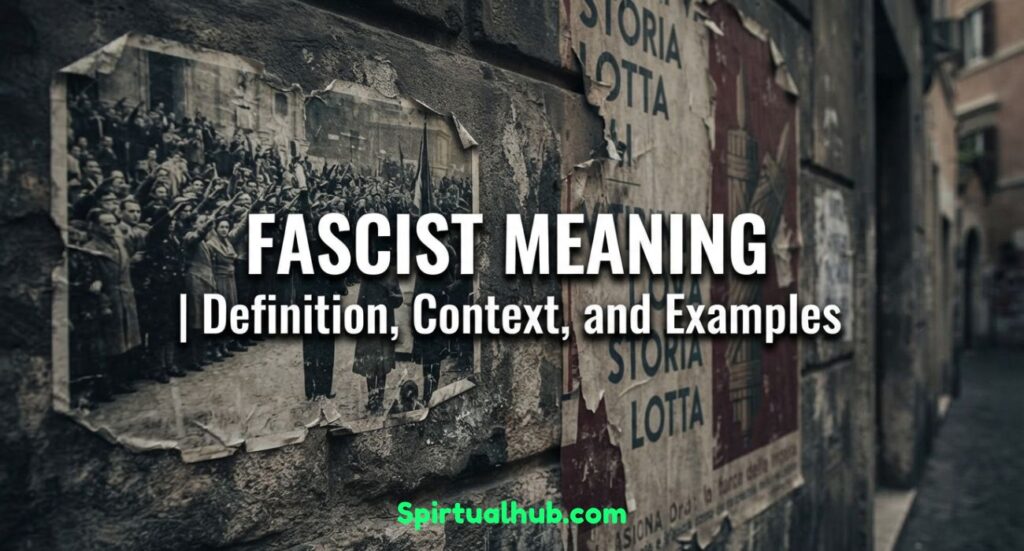
What Tone Does “Fascist” Have?
The word fascist generally carries strong negative connotations. In political and historical discussions, it refers to a serious ideology associated with dictatorship, repression, and attacks on democratic freedoms.
In casual conversation, the tone may be sarcastic, playful, angry, or critical. A person who calls a friend a fascist over a minor disagreement may be exaggerating. Someone who uses the term during a political debate may be making a serious accusation.
The word’s tone alone does not tell you whether the accusation is accurate. You need to consider the person’s meaning and the actions or beliefs being discussed.
Is Fascist Rude?
Yes, fascist can sound rude or offensive when someone uses it to attack another person. Calling someone a fascist may suggest that the person supports oppression or rejects political freedom.
However, the word is not always rude. In a history paper, classroom discussion, or political analysis, it can serve as a descriptive term when the evidence supports its use.
For example, describing a historical government as fascist is different from calling a classmate a fascist simply because they disagree with you.
The situation, tone, and accuracy of the statement determine how appropriate the word is.
Is Fascist an Insult?
Yes, people often use fascist as an insult, especially during arguments about politics or controlling behavior. The label can express strong disapproval or suggest that someone is intolerant of disagreement.
For example:
“Stop acting like a fascist and let everyone share their opinion.”
In this sentence, the speaker uses the word to criticize controlling behavior.
However, fascist is also a legitimate historical and political term. Its use is not automatically an insult when someone applies it accurately to an ideology, movement, or government.
A useful distinction is that using the word to describe a political ideology is not the same as using it to attack a person. The meaning depends on the statement and its supporting evidence.
How to Reply When Someone Calls You a Fascist
If someone calls you a fascist, your response can depend on whether the person is joking, criticizing your behavior, or making a serious political accusation. You do not need to respond with another insult.
A calm reply can help you understand the person’s point and keep the conversation focused on the issue.
If You Want Clarification
Ask the person to explain what they mean and identify the specific statement or action that led to the accusation.
For example:
- “What exactly makes you think that?”
- “Can you explain which of my views you disagree with?”
- “Are you talking about my political beliefs or how I handled this situation?”
These responses encourage a more specific discussion. They also help distinguish a genuine concern from a label used during an argument.
They Are Joking
If a friend uses the word playfully, you can respond with light humor if you feel comfortable.
For example:
- “I’m just trying to keep the rules clear.”
- “Strict rules do not make me a political dictator.”
- “Fine, I’ll relax the rules a little.”
Your response can match the friendly tone without treating the joke as a serious accusation. If the comment bothers you, you can also tell your friend that you do not like being called that.
If It Is a Serious Political Argument
When someone makes a serious accusation, focus on the specific beliefs or actions under discussion.
You could say:
- “Let’s discuss the actual policy instead of using labels.”
- “Which of my views do you believe support authoritarianism?”
- “I disagree with your conclusion, but I’m willing to discuss the reasons.”
If the person identifies a genuine concern, consider the argument rather than dismissing it immediately. If the accusation lacks an explanation, ask for evidence.
A respectful response does not require you to accept an inaccurate label. It allows you to defend your position without turning the disagreement into a personal attack.
When to Use the Term
Use fascist when the subject genuinely relates to fascism or when a careful political analysis supports the description.
Appropriate situations include:
- Historical writing: Describing fascist Italy or examining fascist movements in twentieth-century Europe.
- Political analysis: Discussing a movement’s ideology, extreme nationalism, authoritarian leadership, or suppression of opposition.
- Academic discussions: Explaining the characteristics of fascism and comparing it with other political systems.
- News and public affairs: Describing a political movement when the term accurately reflects its beliefs and actions.
The word can help readers understand a specific ideology when you use it precisely. For example, calling a movement fascist requires more than showing that its members favor strict laws. Its broader political ideas and actions matter.
When discussing modern politicians or movements, explain the reasons for your description. Specific evidence creates a clearer argument than an unsupported label.
When to Avoid the Term
Avoid using fascist as a casual substitute for every strict, unfair, or unpopular person. The word has a serious historical meaning, and careless use can weaken a discussion.
Consider using a more precise word when you mean:
- Strict: Someone enforces rules firmly.
- Controlling: Someone tries to manage other people’s choices.
- Authoritarian: Someone favors concentrated power and limited political opposition.
- Unfair: Someone treats people unjustly.
- Intolerant: Someone refuses to accept different beliefs or opinions.
- Dictatorial: Someone expects others to obey without meaningful discussion or disagreement.
For example, a teacher who enforces a classroom phone policy may be strict, but that alone does not make the teacher fascist.
Similarly, disagreeing with a political party or supporting a particular law does not automatically make someone a fascist. The label should reflect the person’s actual political beliefs or conduct, not merely a disagreement.
Choosing a more accurate word helps prevent misunderstandings and keeps conversations focused on the real issue.
Common Mistakes
People sometimes misunderstand the word fascist because they encounter it in historical texts, political debates, and casual conversations.
Avoid these common mistakes:
| Common mistake | More accurate understanding |
| Treating every strict person as a fascist | Strict behavior alone does not establish support for fascism. |
| Assuming fascist and authoritarian mean the same thing | Fascism is a specific political ideology, while authoritarianism is a broader form of political rule. |
| Calling every dictator a fascist | Dictators can follow different ideologies, so the label requires more context. |
| Assuming the word always functions as an insult | It can also describe a political movement or historical government accurately. |
| Treating every political accusation as a fact | A label should be supported by evidence about the person’s beliefs or actions. |
| Assuming social media jokes reflect genuine political beliefs | People may use the term sarcastically or as an exaggeration. |
Another common mistake is confusing fascism with totalitarianism. The terms overlap, but they describe different concepts. Fascism refers to a political ideology, while totalitarianism describes a system that seeks extensive control over political and public life.
Understanding these distinctions makes it easier to interpret political discussions and use the terms responsibly.
Similar Political Terms
Several political terms relate to fascism, but each has a distinct meaning. Knowing the differences helps you choose the right word for a particular situation.
| Term | Simple meaning | Key distinction |
| Fascism | An ideology associated with extreme nationalism, dictatorial leadership, and political repression | Refers to a particular political tradition. |
| Authoritarianism | A system of rule that concentrates power and restricts political freedom | Covers a wider range of political systems. |
| Totalitarianism | A system that seeks extensive control over political and public life | Emphasizes the scope of government control. |
| Dictatorship | A system in which a ruler or ruling group holds concentrated power without meaningful democratic checks | Describes how political power is held and exercised. |
| Extremism | Support for views or actions far outside accepted norms, sometimes involving violence or coercion | Does not automatically mean fascism. |
| Nationalism | Strong identification with and support for one’s nation | Can take different forms and does not automatically imply fascism. |
| Despotism | Rule through oppressive or arbitrary power | Emphasizes the ruler’s exercise of power rather than a specific ideology. |
These terms sometimes describe the same government or movement from different angles. For instance, a fascist regime may be both authoritarian and totalitarian.
However, the words are not interchangeable. A person can support authoritarian policies without embracing fascism, and nationalism can exist within democratic political systems.
Origin and Historical Use
The word fascist comes from fascismo, the Italian word for fascism. The term developed in connection with the political movement led by Benito Mussolini in Italy during the early twentieth century.
The Italian word fascio means a bundle or group. It is related to the Latin word fasces, which referred to a bundle of rods, sometimes bound around an axe, carried by certain officials in ancient Rome as a symbol of authority. Italian fascists drew on Roman imagery to present their movement as a source of national strength and unity.
Mussolini established a fascist movement after World War I and became Italy’s prime minister in 1922. His regime gradually dismantled democratic institutions and established a dictatorship.
During the twentieth century, fascism became closely associated with authoritarian nationalist movements, political repression, and the rejection of democratic opposition. Nazi Germany developed its own related but distinct form of fascist politics, combining dictatorship and extreme nationalism with a central role for racist and antisemitic ideology.
Read Also: Zionist Meaning | What Does Zionist Mean?
Today, historians use the term to analyze political movements within their historical context. In everyday speech, people may use it more loosely to criticize controlling behavior or political views they strongly oppose.
Understanding the word’s origin helps explain why it carries more weight than ordinary terms such as strict or bossy.
Quick Recap
The fascist meaning refers primarily to a person, movement, or political idea associated with fascism. Fascism combines authoritarian leadership and extreme nationalism with the suppression of political opposition and restrictions on democratic freedoms.
In text messages and online conversations, people sometimes use fascist as an insult or an exaggeration for someone who acts too controlling. That casual use does not necessarily mean the person supports fascism.
The word is related to authoritarianism, totalitarianism, and dictatorship, but these terms have different meanings. A strict person is not automatically a fascist, and a dictator does not necessarily follow fascist ideology.
Use the term carefully when discussing politics, history, or someone’s behavior. Consider the context, examine the evidence, and choose precise language. This approach makes conversations clearer and helps you understand whether someone is discussing a genuine political ideology, criticizing a person’s actions, or simply expressing frustration.
FAQ,S
What is a simple definition of fascist?
A fascist is someone who supports fascism, a political ideology linked to dictatorship, extreme nationalism, and the suppression of opposition.
What is an example of a fascist?
Benito Mussolini is a historical example of a fascist leader who ruled Italy and suppressed political opposition.
What does “fascism” mean?
Fascism is an authoritarian political ideology that promotes extreme nationalism, strong centralized leadership, and limited political freedom.
What are the three main ideas of fascism?
Three main ideas of fascism are extreme nationalism, authoritarian leadership, and the suppression of political opposition.
What country is an example of fascism?
Italy under Benito Mussolini, especially from the 1920s to 1943, is a historical example of a fascist state.
Conclusion
The Fascist Meaning refers to a person who supports fascism, a political system linked to strong leadership, extreme nationalism, and limited freedom. Fascism often involves a dictator who controls the country and silences people who disagree. Italy under Benito Mussolini is a historical example of a fascist state. The word also appears in political discussions, text messages, and social media posts. People sometimes use it to describe someone who acts too strict or controlling. However, this casual use does not always reflect the true political meaning of the word.
Understanding this term helps people discuss politics and history with greater care. Fascist, authoritarian, and dictator have related but different meanings. A strict person does not automatically support fascism. The situation and the person’s beliefs matter when using this word. In online conversations, some people use fascist as an insult during arguments. It is better to explain the problem clearly and avoid unfair labels. Using simple and accurate words helps readers understand the topic and respect different opinions. Careful language also makes political discussions more useful and respectful.
Related Posts:
1: Contingent Meaning | Definition, Usage, and Real-Life Examples
2: Sigma Meaning Slang | The Complete Guide to the Viral Term
3: Agnostic Meaning | What Does Agnostic Mean?