
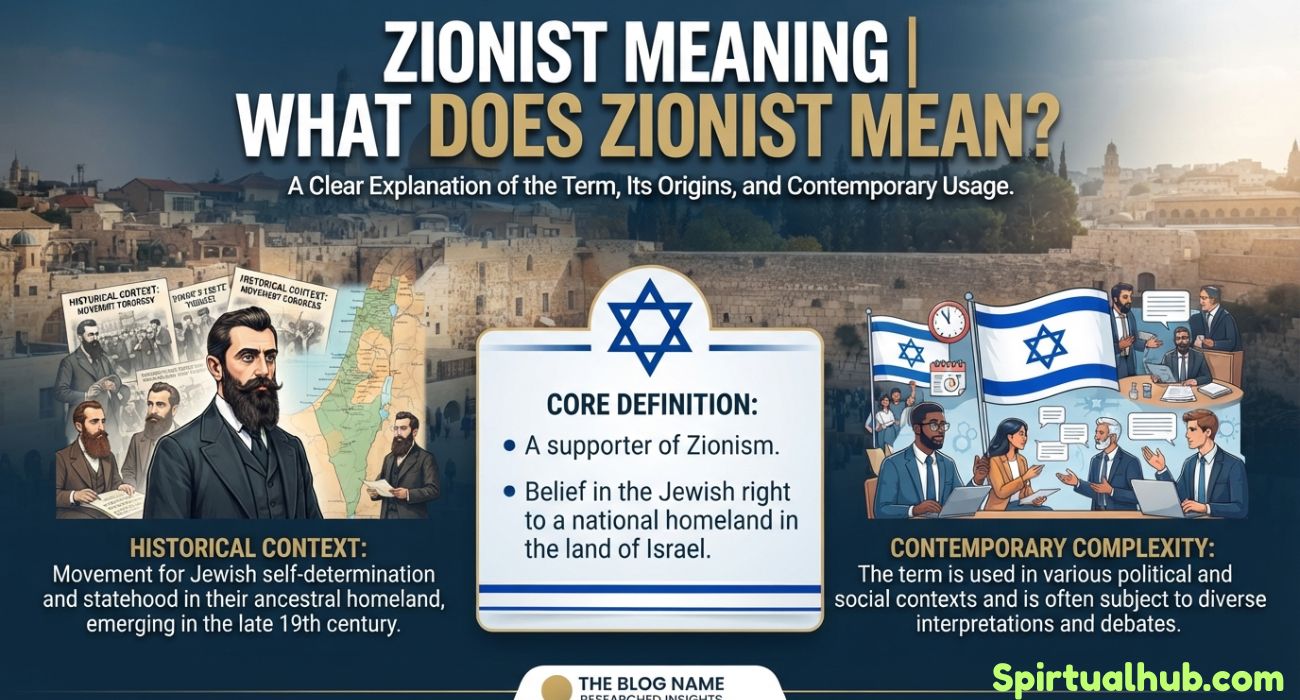
Zionist Meaning | What Does Zionist Mean?
Zionist meaning refers to a person who supports Zionism, a movement that promotes Jewish national self-determination and a homeland in Israel. The term has deep roots in Jewish history, identity, and politics. However, not every Jewish person identifies as a Zionist, and Zionists do not all share the same views.
People use the word “Zionist” in discussions about religion, history, politics, and social media. Its meaning can depend on the speaker and the situation, so it is not always used in the same way. The term itself is not automatically rude or offensive, but people may use it negatively in certain conversations.
This article explains the Zionist definition in simple terms and explores its historical background. You will also learn how Zionism differs from Jewish identity and Israeli nationality, what the term means online, and how context shapes its use.
What Does Zionist Mean?
A Zionist is someone who supports Zionism, a movement based on the Jewish people’s right to national self-determination in their historic homeland, connected to the land of Israel. In modern political discussions, Zionism generally includes support for the existence of a Jewish national homeland in the State of Israel.
The word describes a political or national belief, not a person’s religion or ethnicity. Jewish people can have different views on Zionism, and people who are not Jewish can also support it. The term alone does not tell you someone’s opinions about every Israeli government policy or the rights of Palestinians.
Read Also: Contingent Meaning | Definition, Usage, and Real-Life Examples
What Is the Zionist Meaning in Simple Terms?
In simple terms, Zionist meaning refers to supporting the idea that Jewish people should have a national homeland in their historic homeland. Modern Zionism developed partly in response to antisemitism and the desire for Jewish safety and self-determination.
For example, someone might say, “She is a Zionist because she supports Israel’s existence as a Jewish homeland.” However, Zionists do not all share the same political views. They may disagree about borders, Palestinian statehood, religion, and Israeli government policies.
What Is Zionism?
Zionism is a Jewish national movement that developed in the late 19th century. It sought to establish a national homeland for Jewish people in their historic homeland, an area with deep religious, cultural, and historical connections to Jewish identity.
Political Zionism gained momentum as antisemitism affected Jewish communities in Europe. Supporters argued that Jewish people needed national self-determination and a place where they could build a secure future. The movement contributed to the establishment of the State of Israel in 1948.
Zionism includes different branches and political views. Some supporters emphasize Jewish safety and national identity, while others focus on religious traditions or particular political goals. Critics raise concerns about Palestinian displacement, equal rights, occupation, and national self-determination. Understanding these different perspectives helps explain why Zionism remains a deeply debated political and historical subject.
The Haskala, Theodor Herzl, and modern Zionism
The Haskala, also known as the Jewish Enlightenment, encouraged education, cultural change, and greater participation in European society among Jewish communities. It formed part of the wider historical background to modern Jewish political thought, although it did not represent a single position on Zionism.
Theodor Herzl became a leading figure in modern political Zionism. Antisemitism in Europe, including the Dreyfus Affair in France, influenced his belief that Jewish people needed a national solution to persistent persecution. In 1896, he published The Jewish State, which argued for establishing a Jewish national home.
In 1897, Herzl organized the First Zionist Congress in Basel, Switzerland. The congress helped create an organized political movement around the goal of establishing a publicly recognized homeland for Jewish people in Palestine, then under Ottoman rule. This meeting became an important event in modern Zionist history.
Zionist Meaning in Different Contexts
The word Zionist can carry different tones depending on the conversation. It may describe a historical movement, a person’s political beliefs, or someone’s position on Israel and the Israeli-Palestinian conflict. The surrounding words and the speaker’s purpose help explain its intended meaning.
Historical Context
In history, Zionist usually describes a person who supported the movement for a Jewish national homeland in Palestine. The movement grew in the late 19th century and helped lead to the establishment of Israel in 1948. For example, a history book might describe Theodor Herzl as a Zionist leader because he organized political efforts to establish a Jewish state.
Political Context
In politics, a Zionist generally supports Jewish national self-determination in Israel. However, Zionists can hold different political views about borders, security, Palestinian statehood, settlements, and the actions of the Israeli government.
For example, two Zionists might both support Israel’s existence but disagree strongly about a peace agreement or a government policy. The label does not explain every part of their political position.
Social Media Context
On TikTok, Instagram, and other social platforms, Zionist may appear in discussions about Israel, Palestine, Jewish identity, and current events. Some people use it as a straightforward political label, while others use it as criticism or an insult.
A post calling someone a Zionist does not automatically explain what that person believes. Read the full statement and consider whether the speaker is discussing a specific political position or using the word to attack a person or group.
Religious Context
Zionism has connections to Jewish religious history because Jewish prayers, traditions, and texts have long expressed a connection to Zion and the land of Israel. However, modern political Zionism is not the same as Judaism.
Some Zionists base their support mainly on religious beliefs, while others approach it through national identity, history, or secular political ideas. Jewish people also hold different religious and political views about Zionism.
How Context Changes the Meaning
Context helps you understand whether Zionist describes a person’s beliefs, refers to a historical movement, or expresses criticism. A neutral history lesson may use the word without judgment. A political debate may use it to identify a particular position, while an angry social media post may use it as an insult.
For example, “The speaker is a Zionist” may simply describe the speaker’s political beliefs. However, “Those Zionists control everything” makes a broad accusation and may echo harmful stereotypes about Jewish people. Such language needs careful attention because people sometimes use political terms to disguise prejudice.
Do not assume that every use is offensive or that every criticism of Zionism is antisemitic. Examine the wording, the target, and the claim being made.
Zionism after the founding of Israel
The establishment of Israel in 1948 changed the meaning and political role of Zionism. Before Israel became a state, the movement focused heavily on creating a Jewish national homeland. After 1948, many Zionists focused on supporting Israel’s continued existence, security, and development. Holocaust Encyclopedia
The same period also brought profound loss and displacement for Palestinians. The 1948 war led to the displacement of hundreds of thousands of Palestinians, an event Palestinians call the Nakba, meaning “catastrophe.” These experiences remain central to debates about land, rights, national identity, and justice. United Nations
Today, people who identify as Zionists disagree about many important issues, including Palestinian statehood, settlements, borders, security, and the future of the region. Some support a two-state solution, while others support different political arrangements. The word alone does not tell you which position a person holds.
Read Also: Sigma Meaning Slang | The Complete Guide to the Viral Term
Is Zionist the Same as Jewish or Israeli?
No. Jewish, Israeli, and Zionist have different meanings, although one person may fit all three descriptions.
- Jewish refers to a person’s connection to the Jewish people, which may involve ancestry, culture, religion, or conversion to Judaism.
- Israeli generally describes a citizen or national of Israel. Israelis include Jews and people from other religious and ethnic communities.
- Zionist describes someone who supports Zionism, generally understood as Jewish national self-determination in the historic land of Israel.
Not every Jewish person supports Zionism, and not every Israeli has the same political beliefs. Some non-Jewish people also support Zionism. These terms describe different aspects of identity, nationality, and political belief. Anne Frank Website
Real Conversation Examples
These examples show how people may use Zionist in different situations. The meaning depends on the topic and the speaker’s intent.
1: Historical Discussion
Person A: “We studied Theodor Herzl in history class.”
Person B: “Yes, he was a major figure in the Zionist movement.”
Meaning: The word describes Herzl’s role in the historical movement to establish a Jewish national homeland.
2: Political Conversation
Person A: “She supports Israel’s right to exist, but she criticizes some government policies.”
Person B: “Those views can fit within Zionism. Supporting Israel’s existence does not require agreeing with every government decision.”
Meaning: The conversation distinguishes support for Israel’s existence from support for specific political policies.
3: Social Media Argument
Person A: “That person is a Zionist, so I disagree with their post.”
Person B: “Which political view in the post do you disagree with?”
Meaning: The word identifies a political position, but the conversation becomes clearer when the speakers discuss the actual belief or policy instead of relying on a label.
Is Zionist a Neutral or Offensive Word?
Zionist is not automatically a rude or offensive word. In history, journalism, and political discussion, it can serve as a neutral description of someone who supports Zionism.
However, people sometimes use it as an insult or to spread hostility toward Jewish people. For example, using Zionist as a substitute for Jew when making accusations about secret power, money, or control can draw on antisemitic stereotypes.
The word’s impact depends on the wording and context. Criticizing a specific Israeli government policy is not automatically antisemitic. Attacking Jewish people as a group or blaming all Jews for Israel’s actions is different. It is best to identify the exact policy, action, or belief you mean rather than use a broad label to insult people. ADL
Is Zionist the Same as Supporting the Israeli Government?
No. Zionism generally concerns Jewish national self-determination and support for a Jewish national homeland in Israel. Supporting a particular Israeli government means agreeing with some or all of its policies and decisions.
A person can identify as a Zionist while criticizing the Israeli government over its military actions, settlements, leadership, or approach to peace. Another person may support the existence of Israel but disagree with a particular political party or leader.
Likewise, criticizing the Israeli government does not automatically make someone anti-Zionist. To understand a person’s position, look at what they say about Israel’s existence, Jewish national self-determination, Palestinian rights, and specific government policies.
How to Respond When Someone Uses “Zionist”
The best response depends on how the speaker uses the word. A calm reply can help you understand their meaning without turning the conversation into a personal argument.
Polite Clarification
If you are unsure what the speaker means, ask them to explain the specific belief or action they are describing. This can help separate a political disagreement from a personal attack.
For example: “When you say Zionist, do you mean support for Israel’s existence or support for a particular government policy?”
If You Agree With the Label
If you support Zionism and feel comfortable with the label, you can explain your position in clear terms. You do not need to agree with every Israeli government decision to describe your beliefs accurately.
For example: “I support Jewish national self-determination, but I have my own views on Israeli government policies and Palestinian statehood.”
If You Disagree
If you do not identify as a Zionist, explain your own political position instead of arguing over labels alone. You can state your views on Israel, Jewish self-determination, and Palestinian rights clearly and respectfully.
For example: “I do not identify with that term. My views focus on equal rights, safety, and self-determination for both Israelis and Palestinians.”
When to Use the Term
Use Zionist when you want to describe a person, group, or historical movement that supports Zionism. The term can be useful in history lessons, political discussions, news reports, and conversations about Jewish national identity.
For example, you could write, “The Zionist movement played a major role in the establishment of Israel.” You could also say, “The author describes herself as a Zionist but disagrees with several government policies.”
Use the word accurately and avoid guessing someone’s beliefs based on their religion, nationality, or background. When discussing a particular political issue, naming the policy or belief often makes your meaning clearer.
When to Avoid the Term
Avoid using Zionist as a general insult or as another word for Jewish or Israeli. These terms have different meanings, and using them interchangeably can lead to confusion or unfair assumptions.
You should also avoid calling someone a Zionist simply because they are Jewish, live in Israel, or support one Israeli government policy. A person’s actual beliefs matter more than assumptions about their identity.
When you disagree with someone, focus on their specific statement, action, or political position. This approach makes discussions more accurate and respectful. It also helps prevent political disagreements from turning into attacks on Jewish people or any other group.
Read Also: Agnostic Meaning | What Does Agnostic Mean?
Common Mistakes About the Word Zionist
People sometimes misunderstand the word because it appears in discussions about religion, history, politics, and the Israeli-Palestinian conflict. These are some common mistakes to avoid.
- Assuming every Jewish person is a Zionist: Jewish people hold different views about Zionism.
- Assuming every Israeli is a Zionist: Nationality does not automatically determine political beliefs.
- Treating Zionist as another word for Israeli: The terms describe different things.
- Assuming all Zionists support the same policies: Zionists disagree about government decisions, borders, settlements, and Palestinian statehood.
- Calling every criticism of Israel anti-Zionist: Someone can criticize Israeli policies while supporting Israel’s existence.
- Assuming the word is always an insult: It can be a neutral political or historical term.
- Using Zionist to refer to all Jewish people: This confuses a political belief with a broader identity and can encourage harmful stereotypes.
Understanding these distinctions helps you interpret the word more accurately in conversation, news reports, and social media posts.
Similar Terms and Their Differences
Several terms appear alongside Zionist in discussions about Israel, Jewish identity, and Palestinian rights. Although they relate to similar topics, they do not mean the same thing.
| Term | Meaning |
| Zionist | A person who supports Zionism and Jewish national self-determination in Israel. |
| Zionism | The movement or political idea supporting Jewish national self-determination in the historic land of Israel. |
| Anti-Zionist | A person who opposes Zionism. The reasons for this position can vary. |
| Jewish | Relating to the Jewish people, culture, ancestry, or religion. |
| Israeli | Relating to Israel or a person who holds Israeli nationality. |
| Pro-Israel | Supporting Israel, although the specific meaning can vary by context. |
| Antisemitic | Showing prejudice, hostility, or discrimination toward Jewish people. |
The difference between Zionism and anti-Zionism is especially important. Zionism generally supports Jewish national self-determination in Israel, while anti-Zionism opposes Zionism. People who hold these views may explain their positions in different ways.
Criticism of Israeli government policies is not automatically anti-Zionist or antisemitic. The specific words, arguments, and actions determine what a person is expressing.
Origin and Historical Background
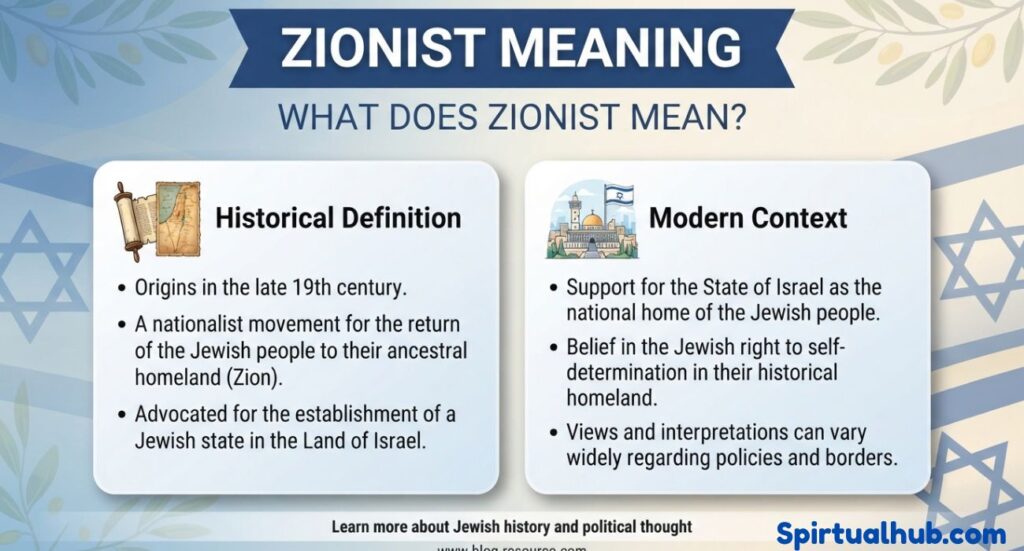
The word Zionist comes from Zion, a name associated with Jerusalem that has deep importance in Jewish history and religious tradition. The term Zionism developed in the 19th century as Jewish thinkers and activists advanced ideas about national identity and a homeland for the Jewish people. HISTORY
Modern political Zionism grew during a period when nationalist movements were spreading across Europe and antisemitism threatened Jewish communities. Theodor Herzl became one of its leading figures after publishing The Jewish State in 1896. The First Zionist Congress met in Basel, Switzerland, in 1897 and helped organize the movement around the goal of a publicly recognized Jewish homeland in Palestine.
The movement contributed to the establishment of Israel in 1948. Since then, the term has remained central to discussions about Jewish national identity, Israeli politics, Palestinian rights, and competing national aspirations. Its meaning in a modern conversation often depends on the historical and political issues being discussed.
Quick Recap
- Zionist meaning: A person who supports Zionism, generally the idea of Jewish national self-determination in Israel.
- Zionism: A historical and political movement focused on a Jewish national homeland.
- Zionist meaning in text: Usually refers to someone’s political beliefs, but the exact meaning depends on context.
- Zionist vs. Jewish: Jewish describes a people, identity, and religion; Zionist describes a political or national belief.
- Zionist vs. Israeli: Israeli relates to nationality, while Zionist relates to support for Zionism.
- Is Zionist offensive? Not inherently, although people sometimes use it as an insult or in antisemitic language.
- Zionist vs. Israeli government supporter: A Zionist can support Israel’s existence while opposing particular government policies.
Understanding these differences helps you use the word accurately and recognize its meaning in history, news, political discussions, and social media.
FAQ,S
Is Zionist the Same as Jews?
No, Jewish refers to a people, culture, ancestry, and religion, while Zionist describes someone who supports Zionism. Jewish people have different views on Zionism, and not all Jews identify as Zionists.
Does Zionism Believe in God?
Zionism itself does not require belief in God because it includes both religious and secular forms. Some Zionists base their views on Jewish religious beliefs, while others focus on history, national identity, and self-determination.
What Do Zionist Jews Believe?
Zionist Jews generally support Jewish national self-determination and a Jewish homeland in Israel. Their views can differ on religion, Palestinian statehood, borders, and Israeli government policies.
What Is the Main Goal of Zionism?
The main goal of Zionism is Jewish national self-determination in the historic land of Israel. The movement contributed to the establishment of the State of Israel in 1948.
Are Zionists Against Palestine?
Not necessarily; Zionists hold different views about Palestinians and Palestinian statehood. Some support a two-state solution, while others oppose it or favor different political arrangements.
Conclusion
The Zionist Meaning refers to a person who supports Zionism, a movement that promotes Jewish national self-determination and a homeland in Israel. Zionism has a long history and played a major role in the creation of Israel in 1948. However, not all Jewish people share the same views about Zionism. Some support it for religious or historical reasons, while others disagree with its ideas or political effects.
Zionists also have different opinions about Palestinians, peace, and the future of the region. Some support a two-state solution, while others hold different political views. The word “Zionist” does not describe every Jewish person, and it does not mean that someone supports every action of the Israeli government. Understanding this term requires learning about history, identity, and politics. Using the word with care helps people discuss this sensitive topic with respect and accuracy.
Related Posts:
1: Hubris Meaning | Definition, Examples, and Context
2: PRN Meaning | What Does PRN Mean in Text and Slang?
3: GNG Meaning | What It Means in Text, Slang, and Social Media