
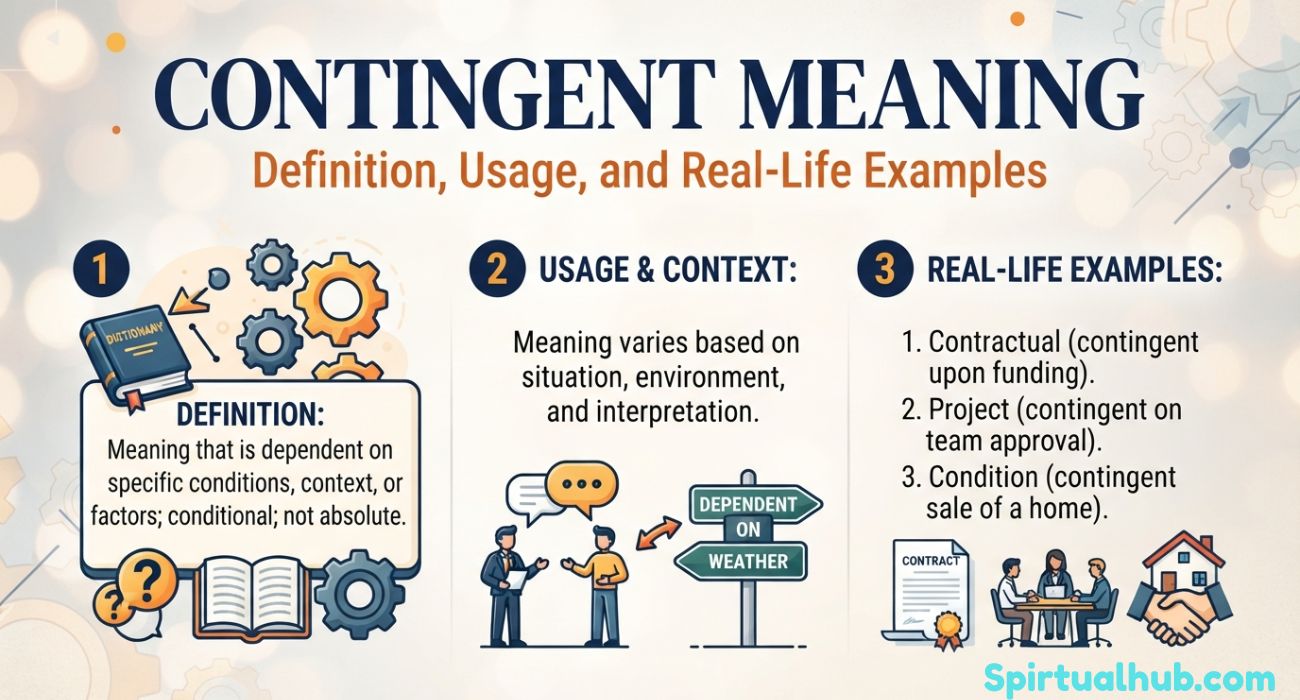
Contingent Meaning | Definition, Usage, and Real-Life Examples
The word contingent means dependent on something else that may or may not happen. When a situation is contingent, it can only proceed if certain conditions are met. For example, a job offer may depend on passing a background check.
You may see this word in work emails, legal agreements, real estate contracts, and everyday conversations. Understanding its meaning helps you recognize when something is certain and when it still depends on another event.
This guide explains the definition of contingent, its different uses, common examples, and related words. You will also learn how to use it correctly in conversations and professional writing.
Quick Answer
| Element | Details |
| Meaning | Dependent on something else or subject to conditions |
| Simple definition | Something will happen only if certain conditions are met |
| Common phrase | Contingent on approval |
| Tone | Neutral to formal |
| Common contexts | Jobs, contracts, real estate, business, and planning |
| Example | “Our trip is contingent on the weather.” |
What Does Contingent Mean?
Contingent means that something depends on another event, condition, or decision. It is not guaranteed to happen because something else must happen first.
For example, imagine your friend invites you to a concert but says, “My attendance is contingent on getting permission from my parents.” This means your friend will attend only if permission is granted.
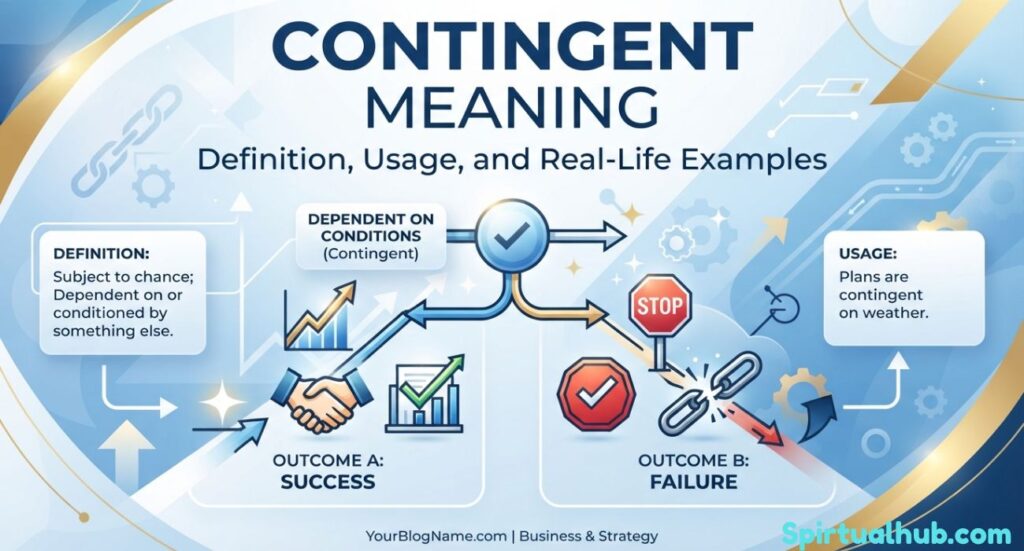
In simple terms, contingent means “it depends.” The word often describes plans, agreements, decisions, or events that rely on specific conditions.
You may also see the phrase “contingent on” in formal writing. For example, “The payment is contingent on completing the project” means the payment depends on the project’s completion.
Full Definition
The word contingent has several meanings depending on how someone uses it. As an adjective, it usually describes something conditional or dependent on an uncertain event. As a noun, it can refer to a group of people representing a larger organization.
The word also appears in law, business, logic, and philosophy. Its central idea remains connected to dependence, conditions, or possibilities.
Adjective Uses
As an adjective, contingent describes something that depends on another factor or may happen only under certain circumstances.
Here are its main uses:
- Conditional: Something happens only when a particular condition is met. Example: “The offer is contingent on approval.”
- Dependent: An event relies on another event or situation. Example: “Our plans are contingent on the weather.”
- Possible but uncertain: Something may happen, but it is not guaranteed. Example: “The company prepared for contingent expenses.”
- In logic: A contingent statement can be true or false depending on the circumstances. It is neither necessarily true nor necessarily false.
The exact meaning depends on the sentence. In most everyday and professional situations, contingent means that an outcome depends on something else.
Noun Uses
As a noun, contingent means a group of people representing a larger organization, country, or community.
For example, “The American contingent attended the international conference.” This means a group representing the United States attended the event.
Other examples include:
- A contingent of journalists covered the meeting.
- The company sent a contingent of engineers to the conference.
- A military contingent participated in the exercise.
This noun meaning differs from the adjective meaning. As an adjective, contingent describes a conditional situation. As a noun, it identifies a group of people.
Context and Usage
The word contingent appears in many settings, but its purpose is usually similar. It explains that something depends on a condition or another event.
Understanding the context helps you determine what must happen before a decision, plan, or agreement can move forward.
Professional and Formal Settings
Contingent is especially useful in professional communication because it expresses conditions clearly. Employers, businesses, lawyers, and real estate professionals use it when discussing decisions that depend on specific requirements.
Here are some common examples:
- Job offers: “Your employment is contingent on passing a background check.”
- Contracts: “Payment is contingent on successful project completion.”
- Real estate: “The purchase is contingent on the home inspection.”
- Business deals: “The agreement is contingent on regulatory approval.”
- Education: “Admission is contingent on meeting the required qualifications.”
In these situations, contingent explains that an offer or agreement is not final until the relevant conditions are satisfied.
Everyday Conversations
People can also use contingent when discussing personal plans, although the word sounds more formal than everyday alternatives such as “depends” or “if.”
For example:
- “Our picnic is contingent on the weather.”
- “My weekend plans are contingent on my work schedule.”
- “The movie night is contingent on everyone finishing their homework.”
Each sentence explains that a plan depends on something happening first.
In casual conversations, you can usually replace contingent with “depends on” without changing the main meaning.
News and Media
News reports use contingent when describing agreements, political decisions, public funding, and events that depend on certain conditions.
For example:
- “The funding is contingent on government approval.”
- “The agreement is contingent on both parties accepting the terms.”
- “The proposed project is contingent on environmental clearance.”
The word helps writers explain why an announcement does not necessarily mean an outcome is final.
When reading news, pay attention to the condition that follows the word. That condition explains what must happen before the reported action can proceed.
Tone and Formality
Contingent has a neutral to formal tone. It does not automatically express a positive or negative opinion.
For example, “The promotion is contingent on performance” simply explains a requirement. It does not mean the promotion is good or bad.
The word works well in professional emails, contracts, reports, and serious discussions. In a casual text, however, “It depends on the weather” usually sounds more natural than “It is contingent on the weather.”
Choose the word that fits your audience and situation.
Real-Life Examples
Original examples make it easier to understand how contingent works in different situations. In each example below, the word explains a condition that must be met before something can happen.
1: Work Email
Subject: Employment Offer
Hello Jordan,
We are pleased to offer you the position of Sales Assistant. Your offer is contingent on completing the required background check and verifying your employment information.
We will confirm your start date once these requirements are complete.
Best regards,
Human Resources Team
Meaning: The candidate can begin the job only after completing the required checks.
2: Group Chat About Plans
Mia: “Are we still going hiking this Saturday?”
Noah: “I’m in, but the trip is contingent on the weather.”
Lily: “That makes sense. We can choose another day if it rains.”
Meaning: The group will go hiking only if the weather allows it.
3: Real Estate
Buyer: “Can we finalize the house purchase this week?”
Agent: “The sale is contingent on the inspection and financing approval.”
Buyer: “So we need to complete those steps first?”
Agent: “Correct. Once the conditions are satisfied, we can move forward.”
Meaning: The home purchase depends on the inspection and financing requirements. The exact effect of those conditions depends on the contract.
4: Academic Setting
Teacher: “Your eligibility for the advanced class is contingent on passing the final assessment.”
Student: “So I need to pass before I can join?”
Teacher: “Yes. Passing the assessment is one of the requirements.”
Meaning: The student must meet a specific academic condition before joining the class.
5: Casual Conversation
Alex: “Are you coming to the birthday party?”
Sam: “My attendance is contingent on getting a ride.”
Alex: “Let me know if you need help arranging one.”
Meaning: Sam will attend only if transportation is available.
Platform-Specific Meaning
Contingent is a standard English word, not a special texting abbreviation or social media slang term. Its basic meaning stays the same across communication platforms.
The difference lies in how people communicate. Formal messages may use contingent, while casual conversations often use simpler phrases.
On WhatsApp, contingent may appear in conversations about travel, work, appointments, or group plans.
For example:
“We can confirm the trip tomorrow. Everything is contingent on the flight schedule.”
This means the group must wait for the flight schedule before finalizing the trip.
In a casual family or friends’ chat, “It depends on the flight schedule” would usually sound more natural.
Snapchat
Contingent is not a common choice for informal Snapchat messages, but someone may use it when discussing plans that are not final.
For example:
A friend sends a picture of a concert ticket with the caption, “Going is contingent on getting a ride.”
The message means the person will attend only if transportation is available.
The word does not have a separate Snapchat meaning. It retains its ordinary English definition.
TikTok
On TikTok, contingent may appear in captions, comments, or videos about plans, decisions, and uncertain outcomes.
For example, someone might write, “My vacation is contingent on saving enough money.”
This means the vacation depends on having enough money saved.
A creator might also use the word humorously in a video about complicated plans. However, the humor comes from the situation, not from a special slang meaning of contingent.
Email and Professional Platforms
Email and workplace platforms are natural places to use contingent. People may use it when explaining job requirements, project deadlines, financial approvals, and business agreements.
For example:
“The project launch is contingent on receiving final approval from the client.”
This sentence clearly explains why the launch cannot proceed until the client approves it.
In professional writing, contingent can help communicate conditions precisely. Always identify the relevant condition so the reader understands what must happen next.
Text Messaging (SMS)
In ordinary text messages, contingent may sound more formal than necessary. Most people use phrases such as “depends on,” “if,” or “only if.”
For example:
Formal: “My attendance is contingent on my work schedule.”
Casual: “I’ll come if my work schedule allows it.”
Both sentences communicate the same basic idea. The first sounds more formal, while the second feels more conversational.
Alternative Meanings
Although contingent most often describes something conditional, it has additional meanings in specific fields.
The surrounding sentence usually makes the intended meaning clear. Pay attention to whether the word describes a condition, a group of people, a logical statement, or a legal obligation.
As a Noun: A Group or Delegation
As a noun, contingent refers to a group representing a larger organization, country, or community at an event or gathering.
For example:
- “A Canadian contingent attended the international summit.”
- “The organization sent a contingent of researchers to the conference.”
- “A contingent of athletes represented their country.”
In these examples, the word identifies a group rather than a condition.
This meaning is common in reports about conferences, international events, sports, and official delegations.
In Logic and Philosophy
In logic, a contingent proposition is a statement that may be true in some circumstances and false in others. It is not necessarily true or necessarily false.
For example, “It is raining outside” is contingent because its truth depends on the actual weather.
In philosophy, contingent claims are often contrasted with necessary truths. A necessary truth must be true, while a contingent claim depends on how things actually are.
This distinction helps explain how people separate facts that could have been different from truths that cannot be otherwise.
In Metaphysics
In metaphysics, a contingent being is something that exists but could have failed to exist. Its existence is not necessary.
For example, a particular tree exists because certain conditions allowed it to grow. That individual tree did not have to exist.
Philosophers contrast contingent beings with necessary beings, which are understood as beings that cannot fail to exist under the relevant philosophical account.
The distinction concerns the nature of existence rather than whether a person has made a plan or agreement.
In Law
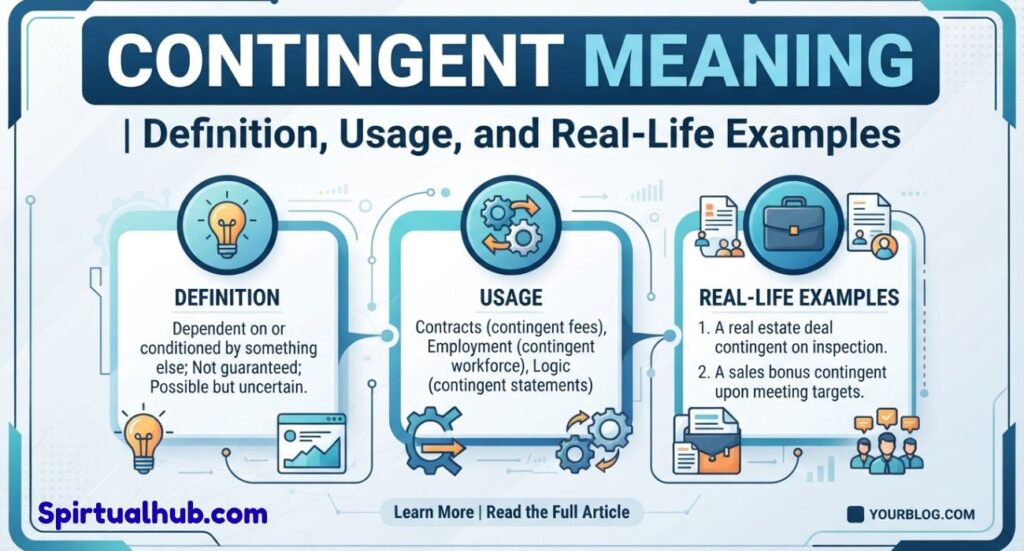
In law, contingent describes an obligation, payment, or event that depends on an uncertain future condition.
For example, a contract may require a buyer to obtain financing before a property purchase can proceed. The agreement’s terms determine what happens if the condition is not met.
Other examples include:
- Contingent liability: A possible financial obligation whose outcome depends on a future event.
- Contingent fee: A fee that depends on a specified outcome, such as the result of a legal case, where permitted by applicable rules and the agreement.
- Contingent debt: A potential debt that becomes payable if a specified condition occurs.
Legal meanings can depend on the contract and applicable law. The word alone does not explain every right or obligation involved.
Related Terms and NLP Variations
Several English words are closely related to contingent. Some describe dependence, while others refer to uncertainty, temporary arrangements, or future possibilities.
Choosing the right term helps you communicate clearly without making a situation sound more formal than necessary.
Synonyms
A contingent synonym is a word that expresses a similar idea. However, not every synonym works in every sentence.
| Synonym | Meaning | Example |
| Conditional | Depends on specific conditions | “The offer is conditional on approval.” |
| Dependent | Relies on something else | “The result is dependent on the weather.” |
| Subject to | Controlled by a condition or rule | “The plan is subject to change.” |
| Pending | Awaiting a decision or event | “The application is pending approval.” |
| Provisional | Temporary or subject to confirmation | “We made a provisional booking.” |
| Uncertain | Not known or guaranteed | “The outcome remains uncertain.” |
Conditional is often the closest synonym when describing an agreement or plan that depends on a requirement.
“Pending” is slightly different because it emphasizes waiting for a decision or event. “Uncertain” describes a lack of certainty but does not necessarily mean a specific condition must be met.
Antonyms
A contingent antonym expresses the opposite idea. The best opposite depends on the sentence.
| Antonym | Meaning | Example |
| Unconditional | Not dependent on conditions | “The gift came with no conditions.” |
| Certain | Known or sure to happen | “The date is certain.” |
| Guaranteed | Assured under the stated terms | “The payment is guaranteed.” |
| Absolute | Not limited or qualified in the relevant sense | “The statement made an absolute claim.” |
Unconditional is often the clearest opposite when contingent describes something that depends on specific requirements.
However, contingent and uncertain are not perfect opposites of certain in every context. A contingent event may become certain once its conditions are satisfied.
Common Phrases
Contingent appears in several common expressions. Learning these phrases makes it easier to understand the word in contracts, conversations, and professional writing.
- Contingent on: Dependent on something. Example: “The event is contingent on good weather.”
- Contingent upon: Another way to say contingent on, often with a more formal tone. Example: “Payment is contingent upon delivery.”
- Contingent offer: An offer that depends on specified conditions being met.
- Contingent plan: A plan that depends on certain circumstances or conditions.
- Contingent liability: A possible financial obligation that depends on a future event.
- Contingent fee: A fee that depends on a specified result or outcome.
- Contingent expenses: Possible expenses that may arise under certain circumstances.
The phrase “contingent on” is especially useful because it connects the condition to the result. In clear writing, explain what the outcome depends on rather than leaving the condition unstated.
Lexical Variations
Contingent has related forms that serve different grammatical purposes.
| Word | Part of Speech | Meaning |
| Contingent | Adjective or noun | Conditional, dependent, or a representative group |
| Contingency | Noun | A possible future event or condition |
| Contingently | Adverb | In a conditional or dependent manner |
| Contingentness | Noun | The state or quality of being contingent |
For example, “The payment is contingent on delivery” uses the adjective.
“We prepared for every contingency” uses the noun to describe a possible future event.
“Contingently approved” uses the adverb to indicate conditional approval, although the exact phrasing depends on the context.
The distinction between contingent and contingency is especially important because the two words have related but different grammatical roles.
How to Respond When Someone Uses “Contingent”
When someone says a plan or decision is contingent, they mean that something else must happen before the outcome is certain.
Your response should focus on the condition, the expected timing, or the next step. The right reply depends on whether you are discussing personal plans, work, or an agreement.
Response Strategies
Use these approaches to understand the situation and respond clearly.
- Ask about the condition: Find out what must happen first.
- Confirm your understanding: Make sure you understand what the outcome depends on.
- Ask about timing: Find out when the person expects to have a definite answer.
- Discuss alternatives: Consider what happens if the condition is not met.
- Show flexibility: Acknowledge that the final decision may take time.
For example, if a coworker says a project is contingent on approval, you can ask when approval is expected. If a friend says a trip depends on the weather, you can suggest another date.
Example Responses
Here are natural replies for different situations:
- At work: “Understood. When do you expect to receive approval?”
- About travel: “Okay, so the trip depends on the weather. Let’s make a backup plan.”
- About a job offer: “Thanks for explaining. Could you tell me which requirements I still need to complete?”
- About a purchase: “Got it. What happens if the financing is not approved?”
- In a casual chat: “No problem. Let me know when your plans are confirmed.”
These replies show that you understand the uncertainty without making assumptions about the final outcome.
When to Avoid Using “Contingent”
Although contingent is correct in many situations, simpler wording may communicate your meaning more naturally.
Avoid using it when:
- The conversation is very casual: “It depends” is usually easier to understand.
- The situation is personal: Direct, warm language may sound more natural.
- The message is very short: “If I finish work early, I’ll come” is clearer than “My attendance is contingent on my schedule.”
- The audience may not know the word: Use familiar language when clarity matters more than formality.
Choose contingent when you need to express a specific condition precisely. Choose a simpler alternative when it makes the message easier to understand.
Misinterpretations and Common Mistakes
Contingent is not difficult to understand once you recognize its central meaning. However, a few common mistakes can make sentences confusing or inaccurate.
1: Using It as Slang
Contingent is a standard English word, not a slang abbreviation. It can appear in texts and social media posts, but its meaning does not change simply because someone uses it online.
For example, “The party is contingent on my parents saying yes” is grammatically correct.
However, “The party depends on my parents saying yes” sounds more natural in an informal conversation.
Use contingent when the formal tone fits the situation rather than treating it as a trendy expression.
2: Confusing “Contingent” with “Contingency”
Contingent and contingency are related words, but they serve different grammatical purposes.
Contingent usually describes something that depends on a condition. Contingency is a noun that often refers to a possible future event or situation.
Compare these examples:
- Correct: “The trip is contingent on the weather.”
- Correct: “We need a contingency plan in case the weather changes.”
The first sentence explains a condition. The second describes preparation for a possible problem.
Remember that contingent often describes a relationship between a condition and an outcome, while contingency names a possibility that may require planning.
3: Forgetting the Preposition
When contingent means dependent on something, it commonly takes the preposition on or upon.
For example:
- Incorrect: “The agreement is contingent the approval.”
- Correct: “The agreement is contingent on approval.”
- Correct: “The agreement is contingent upon approval.”
Both correct forms explain what the agreement depends on. “Contingent on” is generally a straightforward choice for everyday professional writing.
4: Using It When You Mean “Likely”
Contingent does not simply mean likely. The two words express different ideas.
Likely means something has a good chance of happening. Contingent means something depends on a condition or circumstance.
Compare:
- “Rain is likely tomorrow.” This means rain has a good chance of occurring.
- “The picnic is contingent on the weather.” This means the picnic depends on the weather.
An event can be likely without being contingent on a particular condition. Choose the word that expresses your intended meaning.
5: Overusing It
Contingent is useful, but repeating it too often can make writing sound stiff.
For example, instead of writing, “The trip is contingent on the weather, and our booking is contingent on the trip,” you could write, “The trip depends on the weather, and we will confirm the booking once the forecast improves.”
The revised sentence communicates the relationship more clearly and avoids repetition.
Use alternatives such as “depends on,” “conditional,” and “subject to” when they fit the sentence.
When NOT to Use Contingent
Contingent is not the best choice for every situation. Although it is grammatically correct in many contexts, its formal tone may make simple messages harder to read.
Consider your audience and purpose before choosing the word.
Casual Conversations
In conversations with friends, family, or classmates, simple expressions often sound more natural.
For example:
- Formal: “My attendance is contingent on my schedule.”
- Casual: “I’ll come if my schedule allows it.”
Both sentences express the same condition. The second is more direct and easier to understand in an everyday conversation.
Emotional or Personal Messages
When discussing feelings or personal relationships, contingent can sound distant if a simpler phrase would express the same idea more warmly.
For example, “My decision is contingent on your response” may sound formal or businesslike.
A more natural alternative could be, “I’ll decide after I hear from you.”
The better choice depends on what you want to communicate. Use direct language when it helps the other person understand your feelings or intentions.
Social Media Posts
Short social media posts often benefit from simple wording. Contingent may sound unnecessarily formal when discussing ordinary plans.
For example:
- Formal: “My attendance is contingent on ticket availability.”
- Casual: “I’ll go if I can get tickets.”
The casual version communicates the same idea with fewer words.
However, contingent can still fit a professional post or a discussion about contracts, policies, and formal decisions.
When You Want to Sound Approachable
If your goal is to sound friendly and easy to understand, choose language that suits your audience.
For example, “The meeting depends on the manager’s approval” is often more approachable than “The meeting is contingent upon managerial authorization.”
Both communicate a condition, but the first uses more familiar words.
Clear writing does not require complicated vocabulary. Use contingent when it adds precision, not simply to make a sentence sound formal.

Usage Tips
Using contingent correctly becomes easier when you identify the condition, explain the result, and choose language appropriate for your audience.
These practical tips can help you use the word naturally in writing and conversation.
1: Always Include the Condition
When using contingent to describe dependence, explain what the result depends on.
For example, “The event is contingent” leaves the reader wondering about the condition.
A clearer sentence is, “The event is contingent on the venue being available.”
The second version identifies the requirement and helps the reader understand what must happen before the event can proceed.
2: Use It for Important Matters
Contingent works particularly well when discussing agreements, employment requirements, business decisions, and formal plans.
For example, “The job offer is contingent on completing the required checks” clearly states an employment condition.
For a simple decision, such as choosing a movie, “It depends on what everyone wants to watch” sounds more natural.
Match the word to the seriousness and formality of the situation.
3: Pair It with Clear Timing
When a decision depends on an uncertain event, people may also need to know when they will receive an update.
For example, “The offer is contingent on the background check, and we expect to provide an update within five business days.”
This sentence explains both the condition and the expected timeline.
Only provide a specific timeline when you have a reasonable basis for it. Otherwise, explain that the timing has not yet been confirmed.
4: Offer a Backup Plan
When discussing uncertain plans, a backup option can help everyone prepare for different outcomes.
For example, “The outdoor event is contingent on the weather. If it rains, we will move the gathering indoors.”
The first sentence explains the condition. The second gives an alternative if that condition is not met.
A backup plan is especially useful for travel, events, appointments, and projects that depend on outside circumstances.
5: Practice with Synonyms
Practicing related words helps you recognize when contingent is the best choice.
Try comparing these sentences:
- Contingent: “The payment is contingent on delivery.”
- Conditional: “The offer is conditional on approval.”
- Dependent: “The result is dependent on the available resources.”
- Subject to: “The schedule is subject to change.”
- Pending: “The application is pending approval.”
These expressions have related meanings, but they are not always interchangeable. Learning their differences will help you choose precise, natural wording.
FAQ,S
What Is a Contingent Example?
A job offer contingent on a background check is a common example. The person gets the job only after passing the required check.
What Does Contingent Mean in Real Life?
In real life, contingent means something depends on a specific condition or event. For example, a picnic may be contingent on good weather.
How Do I Use Contingent in a Sentence?
You can say, “Our trip is contingent on the weather.” This means the trip will happen only if the weather is suitable.
What Does Contingent Mean for Kids?
Contingent means something can happen only when a certain condition is met. For example, you can go outside if you finish your homework.
What Is Another Word for “Contingent”?
Some synonyms for contingent include dependent, conditional, and subject to. The best word depends on how you use it in a sentence.
Conclusion
The Contingent Meaning refers to something that depends on a certain condition or event. It explains that something may happen only when a specific requirement is met. For example, a job offer may depend on passing a background check. A family trip may depend on good weather. These are simple examples of how people use the word contingent in daily life. Understanding this word helps you read contracts, job offers, business agreements, and everyday messages with more confidence.
The word contingent can have different uses in different situations, but its main idea stays the same. It shows that an event or result depends on something else. Words like dependent and conditional have similar meanings, although their use may change with the sentence. You can improve your English by reading examples and practicing simple sentences with contingent. This will help you understand the word more clearly and use it correctly in writing and conversation. Learning new words step by step makes English easier to understand and use every day.
Related Posts:
1: PRN Meaning | What Does PRN Mean in Text and Slang?
2: GNG Meaning | What It Means in Text, Slang, and Social Media
3: The Spiritual Meaning of Dreaming About Your Ex